
Max Planck Institute for Sustainable Materials and partners published a Science Advances paper on October 15, 2026 that reframes scrap impurities as alloying ingredients. Instead of diluting contaminated feedstock with virgin iron, their machine-learning loop designs ductile-iron chemistries and process windows that tolerate — and exploit — the dirt. For industrial MAT teams, that is a materials-data problem as much as a furnace problem.
The team used ductile iron — roughly 120 million tons a year worldwide — as the model alloy because it already tolerates impure charge mixes. A tree-search guided by neural surrogates proposed candidates; 17 were melted and tested. Fourteen landed at the front of the recycled-iron strength–ductility frontier: up to 15.2% higher tensile strength at comparable elongation, or up to 73.2% more elongation at comparable strength, with manufacturing cost about 8.1% below the usual scrap-plus-virgin blend.
Dr. Liuliu Han, a corresponding author at Max Planck, put the industrial bite plainly: diluting impurities with virgin metal burns the environmental case for recycling. Linking composition and processing (temperature, time) directly to tensile strength and elongation — without leaning hard on microstructure features first — lets the optimizer stay inside scrap-compatible chemistries. Experimental results feed back into the models, so each round tightens the recommendations for the next melt.
The same mid-October window kept pushing electrode and coating chemistry for electrified products. Fraunhofer IPA and the University of Stuttgart patented an aluminium-foil anode that is both active material and current collector — no graphite, no silicon, no copper foil — aimed at safer specialty cells. Separately, ACS work on dry-mixed Al2O3 nanoparticles showed a spontaneous Li–Al oxide skin on Ni-rich NMC that improved high-temperature retention. Together with the scrap-alloy paper, the week’s theme is clear: design the material around the feedstock and interface you actually have.
For N23D, “dirty alloy” design only scales when composition, heat-treat, and test data stay attached to the part revision in PLM and the charge recipe on the floor in MES. A surrogate that picks a scrap-tolerant grade is useless if the BOM still assumes virgin dilution and the shop can’t see which impurity window was approved.
Expect more scrap-first alloy programs as CO2 and critical-material pressure rises. The shops that win will treat impurity assays as design inputs — not quality escapes — and keep the digital thread honest from melt practice to released material spec.
Sources
- Max Planck Institute for Sustainable Materials: Turning scrap impurities into enhanced alloys (Oct. 15, 2026)
- Science Advances: From scrap to prime — designing high-performance alloys from dirty feedstocks with machine learning (DOI: 10.1126/sciadv.aeg9183)
- electrive: Fraunhofer stabilises aluminium anodes for lithium-ion batteries (Oct. 13, 2026)
- phys.org: AI turns scrap impurities into useful ingredients for stronger recycled iron
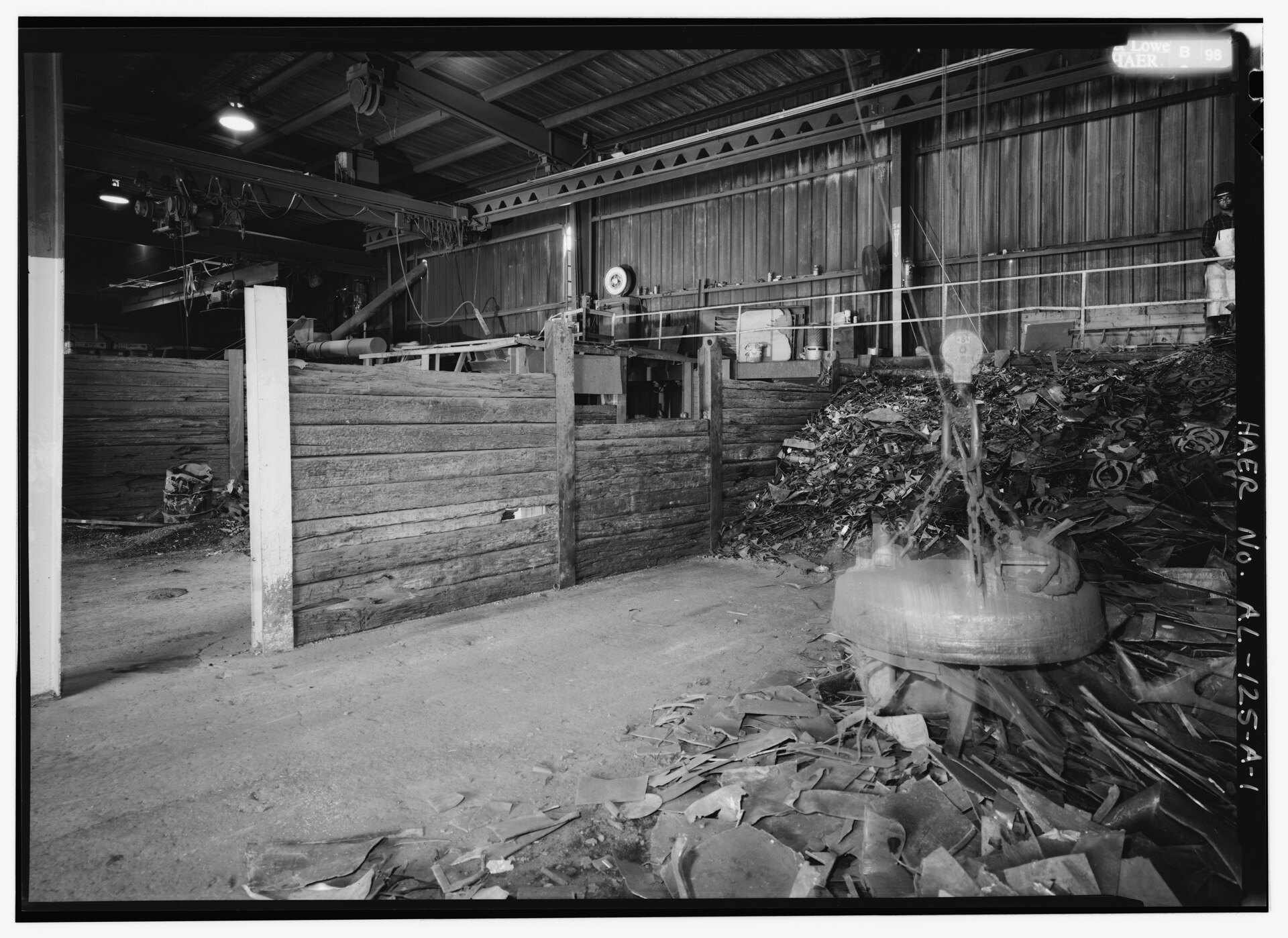
Featured photo: Southern Ductile Casting Company scrap bins (HAER) via Wikimedia Commons.