Take a typical week in a sheet metal shop. Epifor’s forecasting flags that an order will finish after its delivery date, and the production manager asks the system why. Its AI agents trace the answer across the floor: assembly needs 8.5 more hours on Friday than it has, because welding lost 7.5 hours earlier in the week to missing raw material and the work stacked up behind it. That is the example Epifor MES general manager Giannis Savvaidis gave in a Nov. 3 interview with Machine Tool News about the agentic AI the company has built into its manufacturing execution system. The agents then suggest which orders to group, what to run next and where to add hours, based on the plant’s own planning rules.
Epifor follows the order, not the machine. Operators report progress from a tablet or phone at each work center, orders come in from the ERP and quantities go back. On request, the agents can change a target date, a routing or a field in an order within the user’s permissions, and an MCP connector passes production data to ChatGPT, Claude and Copilot. Go-live takes up to four months. The hard part is underneath: a 2026 Rockwell Automation study of 1,560 manufacturing and industrial decision-makers found only 23% reported full integration across ERP, PLM, quality and operational technology, 44% ranked integration as their top MES buying requirement, and 43% said they were not effectively using the data they already collect.
Rockwell is pushing AI into the same seam from the quality side. On Nov. 1 it announced an API integration between Plex QMS and FactoryTalk Analytics VisionAI that runs AI inspection workflows on new and existing camera systems. Rockwell says traditional visual inspection is only 80% effective and often fails to keep an inspection history; recording results in Plex adds traceability, product serialization and a record of every check. Plex Connected Worker also added an AI authoring agent that turns CAD files and technical assets into step-by-step work instructions for frontline employees.
In Finland, automation integrator JTA Connection moved its MES business into a new subsidiary, JTA Nexus Oy, to sell Nexus MES worldwide as a standalone product. Nexus sends jobs and transport orders to machines, robot cells, AMRs, AGVs and conveyors, and guides operators through manual tasks in the same flow. When a shift ends, materials, NC programs and the next jobs are ready so CNC machines and robot cells keep running. Customers can start with a single cell and grow to the whole factory.
All three move decisions closer to the floor and make them faster. That raises the cost of bad inputs. An agent that traces a late order to missing steel is only right if the routing and the bill of material it reads are the released ones. A work instruction generated from a CAD file is only safe if it is the current revision. Machine Tool News put it plainly: the question is not whether AI can answer in a demo, but whether the factory data is complete, timely and reliable enough to support a real production decision — and with 77% of plants not fully integrated, most are not there yet.
N23D builds MES into the same Rust application as CAD, PLM, ERP and QMS. A work order, its routing, the released geometry, the inspection plan and the purchase order for the steel are one record, not five copies synced by integrations. When an agent asks why an order is late, it sees the missing material, the revision being built and the open inspection results together, and it acts with the same permissions and approval history as the person who asked.
Sources
- Epifor MES Brings Agentic AI to Factory-Wide Production Planning, Machine Tool News (Nov. 3, 2026)
- Rockwell Automation Integrates Plex QMS With FactoryTalk Analytics VisionAI, Manufacturing News (Nov. 1, 2026)
- Nexus MES becomes an independent company to grow globally, JTA Connection (Nov. 3, 2026)
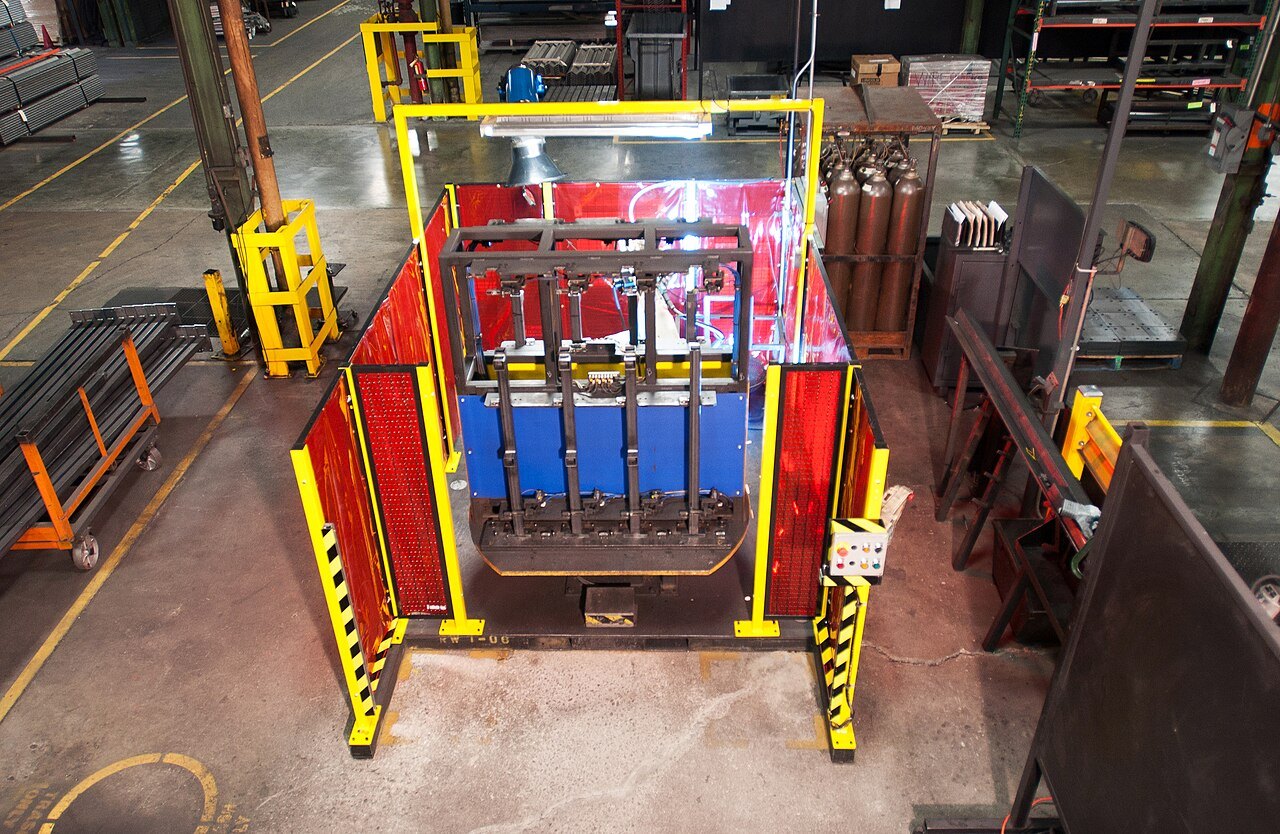
Featured photo: A robotic welding cell with weld curtains for machine guarding. Photo: WireCrafters, CC BY-SA 4.0, via Wikimedia Commons.