
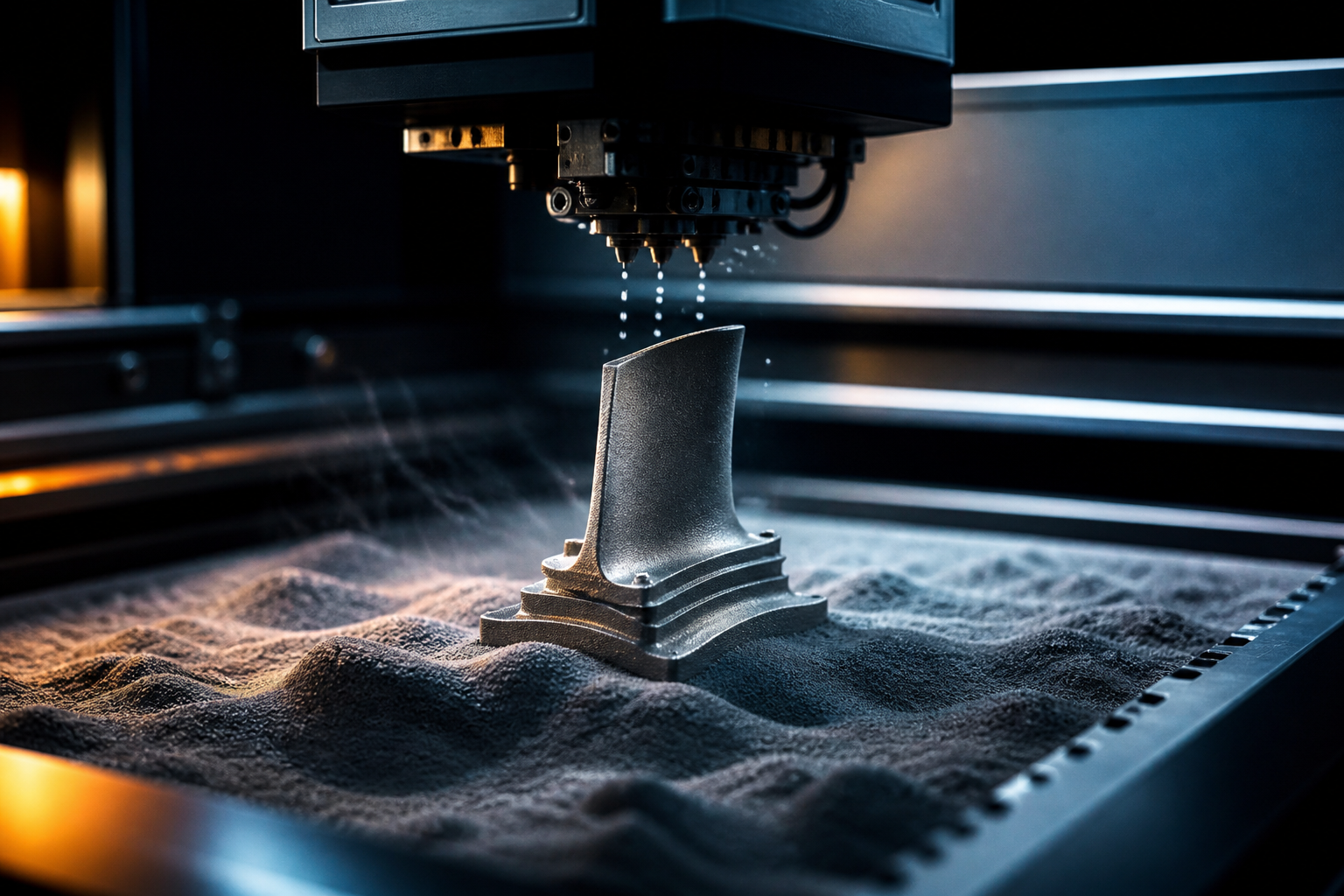
Metal binder jetting is no longer stuck in “almost ready.” This month’s signal is industrial: AmPd Labs published the first third-party validated mechanical dataset for MAR-M 247LC, a nickel-base superalloy used in hot-section turbine hardware, produced on metal binder jetting with Continuum’s gas-atomized powder. An independent ISO/IEC 17025 lab reported ultimate tensile strength in the cast range while elongation came in roughly two to four times higher than typical investment castings, with tight specimen-to-specimen consistency. For aerospace, defense, and energy teams that live with months of casting tooling and lead time, that is a credible second path for complex, lower-volume, high-temperature parts—if qualification work continues to hold.
Sustainability is moving with performance, not against it. Continuum and AM Research have been pressing the feedstock question: as metal AM scales, where does the powder come from, and can recycled routes feed high-value alloys without wrecking properties? In parallel, University of Sheffield researchers showed 316L binder jetting with a heated printhead and a low-saturation aqueous PVA binder (about 20% saturation), reaching roughly 99% relative density after vacuum sintering without HIP. That approach cuts VOC-heavy resin binders and carbon residue while still delivering usable green strength and sintered hardness and tensile numbers. Cleaner chemistry plus densification that does not require HIP is the kind of process detail that turns pilot cells into production cells.
Taken together, the week’s story is not a new consumer FDM gadget. It is metal AM climbing the qualification ladder: tougher alloys, independent data, and greener binders that still densify. For N23D’s own digital-thread and manufacturing roadmap, that matters. Parts that can be printed, sintered, and traced into a BOM and ECO cycle are exactly the closed loop CAD, PLM, and process planning are supposed to own. The printers are catching up to the software problem we are building to solve.
Sources
- AmPd Labs — binder jetting and MAR-M 247LC superalloy work: ampdlabs.com
- Continuum Powders — sustainable metal powder feedstock: continuum-powders.com
- VoxelMatters — industrial AM industry coverage: voxelmatters.com
- 3DPrint.com — additive manufacturing news: 3dprint.com
- University of Sheffield — aqueous PVA binder research for binder jetting: sheffield.ac.uk




Leave a Reply