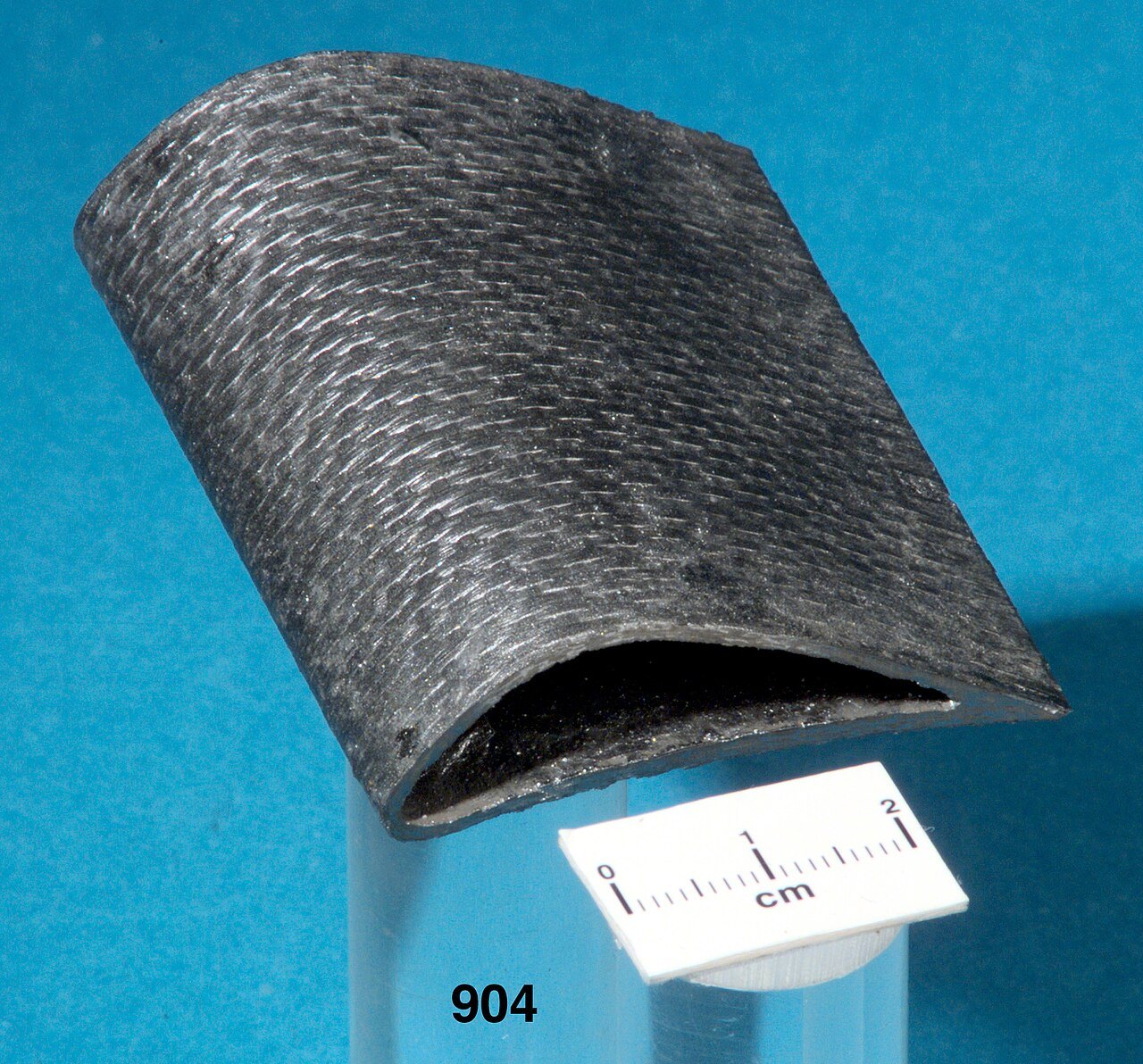
The nickel superalloys inside today’s jet engines top out at around 1,000°C. Silicon carbide ceramic matrix composites, or CMCs, keep working at around 1,650°C and cut down on the cooling air engines now spend to keep metal parts alive. On Oct. 28 a UK consortium reported that it had built and finished a CMC aerofoil demonstrator, the curved blade-shaped part that steers airflow through an engine. The team was coating specialist Archer Technicoat (ATL) and two High Value Manufacturing Catapult centres, the University of Sheffield’s Advanced Manufacturing Research Centre (AMRC) and the Manufacturing Technology Centre (MTC).
The news is less the material than the route to a finished part. ATL turned woven silicon carbide fibres into a solid aerofoil by chemical vapour infiltration, using a graphite mould developed with the German Aerospace Center (DLR). MTC trimmed the excess composite with a laser, so no cutting tool wore down on the abrasive ceramic. The AMRC then ground the curved aerodynamic surfaces on a CNC machine, using metrology models to hold the shape, and drilled small fastening features with core drills without cracking the brittle part. The consortium says the full three-step route has reached technology readiness level 5, meaning it has been shown in a relevant environment, not yet in production.
Metals are being pushed too. A Nature paper led by UC Berkeley and Lawrence Berkeley National Laboratory scientists, with bulk samples made at UC Irvine, describes two refractory high-entropy alloys, Nb45Ta25Ti15Hf15 and Nb70Ti30, that stay tough from 20 kelvin (−423°F) up to 1,300°C. They measured fracture toughness of 100 MPa√m at cryogenic temperatures and more than 250 MPa√m at room temperature, well beyond the toughest body-centered cubic metals such as steel. That matters because BCC metals usually turn brittle in the cold. UC Irvine professor Diran Apelian made the samples by electric arc and plasma melting of pure elements, then rolled them, and the U.S. Department of Energy funded the work.
Other hot-section news this week was about qualification, not new chemistry. On Oct. 29 Norsk Titanium said Rolls-Royce had issued a purchase order for a Ti-6Al-4V structural part made by its wire-fed Rapid Plasma Deposition process, being explored for current civil engine programs, with final machining done in Germany. The same day Northrop Grumman described its CERAPRINT 3D-printed silicon carbide, which it says has effectively zero porosity, isotropic properties and U.S. National Security Space certification for optical and structural parts.
In all four stories the property sheet depends on the process. A CMC aerofoil’s strength depends on its fibre weave, how far the infiltration went and whether grinding or drilling started a crack. The Berkeley alloys were melted, then rolled, and a different route could give different toughness. A printed titanium part is approved for one machine, one wire and one set of parameters. When the material data lives in a spreadsheet, the process route lives in a traveler and the simulation uses a handbook number, nobody can tell whether the part that was analyzed is the part that was made.
N23D keeps materials in the same Rust application as the geometry and the product record. A material in N23D is a released record that carries its process route, its test results and the conditions they were measured at, not just a single modulus and yield value. CAE studies read properties from that record, CAM operations such as laser trimming or abrasive grinding are tied to it, and a change to the process goes through the same approval as a change to the drawing. The part that was simulated and the part that was made point to the same record.
Sources
- Ceramics breakthrough drives onshore next-gen engine component builds, University of Sheffield AMRC (Oct. 28, 2026)
- UCI Engineers Help Forge a Metal That Can Handle Extreme Temperature Changes, UC Irvine Samueli School of Engineering (Oct. 26, 2026)
- Norsk Titanium Approved Supplier for Rolls-Royce Development Activities, Norsk Titanium (Oct. 29, 2026)
- Additive Acceleration: How Northrop Grumman Is Scaling Strategic Manufacturing Capability, Northrop Grumman (Oct. 29, 2026)
Featured photo: A silicon carbide fiber-reinforced silicon carbide (SiC/SiC) vane at NASA Glenn Research Center, 2002. NASA photo by Tom Jares, public domain, via Wikimedia Commons.