OpenAI said on Nov. 3 that its own hardware and infrastructure teams now use Codex and ChatGPT to create and revise CAD models, turn 3D designs into 2D manufacturing drawings, set up simulations and FEA, and review designs for robotics and compute infrastructure. Model usage across those teams, measured in tokens, has grown 23-fold since February. “We’re iterating faster across CAD, converting 3D designs into production-ready 2D drawings, and setting up simulations and FEA with far less manual work,” said Grace Lam, a forward deployed engineer at OpenAI. As TechRepublic noted, that figure measures usage, not productivity.
The more useful part is what went wrong. Two OpenAI employees used GPT-6 Astra to design a small device, from enclosure and circuit board to firmware, in under a week as a side project, with no direct human edits, and a contract manufacturer built a small batch in under a month. But getting it ready for manufacturing took several rounds of review, because Astra “did not consistently account for the manufacturer’s production limits, tolerances, or details required for assembly.” On OpenAI’s BenchCAD 2.0 test, which asks models to rebuild 3D parts and assemblies and trace circuit-board connections, a newer internal model scored 0.875 against 0.594 for Astra. OpenAI is also working with Chip Ganassi Racing to turn 3D scans of old parts into editable CAD and drawings, with engineers checking every result.
Autodesk shipped the other half of this story the same day. Inventor 2027.2 now includes a local MCP (Model Context Protocol) server that lets an outside agent such as Cursor, Claude Code or GitHub Copilot inspect and modify the model in an Inventor session you already have open, using the same tools as the built-in Autodesk Assistant. Autodesk’s own example builds a 3D model from an attached AutoCAD drawing with one prompt. The Assistant can now write iLogic rules with event triggers, such as a rule that checks a design against company standards every time it is saved, and it accepts up to five uploaded files at a time, including PDFs of company standards.
The rest of the release is everyday assembly work: a separate button for each constraint type, multi-select tangent constraints, placing a bolt and washer together, and status icons that flag model states whose generated files are out of date before you place them. Two days later, Autodesk opened Informed Design for Fusion as a public beta, so manufacturers can publish configurable Fusion products as Revit families with their own BIM data. The beta does not yet include bills of materials, 2D drawings or iLogic-style rules. At Autodesk University, the company also said Autodesk Assistant will become a standalone agent that works across products, expected next year.
Put the two announcements together and the gap is clear. Agents can now open a live CAD session, change geometry and produce drawings, but OpenAI’s own test shows the misses land on production limits, tolerances and assembly details, which usually live outside the CAD file in a shop’s routings, a supplier’s capabilities and a PLM system’s change history. An agent working through a local connection to one desktop session sees the model, not whether that part is released, who approved the last change, or what the machine on the floor can actually hold.
In N23D, CAD lives in the same Rust application as CAM, PLM and the change control board. An agent edits the same part record a person does, with the same permissions, and its change goes through the same approval with full history before anything is released. Manufacturing limits and tolerances sit next to the geometry instead of in a separate system, so an agent designing a part can check what the shop can make before a reviewer has to catch it.
Sources
- Accelerating engineering for the physical world, OpenAI (Nov. 3, 2026)
- OpenAI expands AI engineering tests to hardware, TechRepublic (Nov. 2026)
- Autodesk Inventor 2027.2 what’s new, Autodesk (Nov. 3, 2026)
- Informed Design for Fusion is now in open beta, Autodesk Fusion Blog (Nov. 5, 2026)
- Autodesk’s most ambitious AI play yet, DEVELOP3D (Nov. 5, 2026)
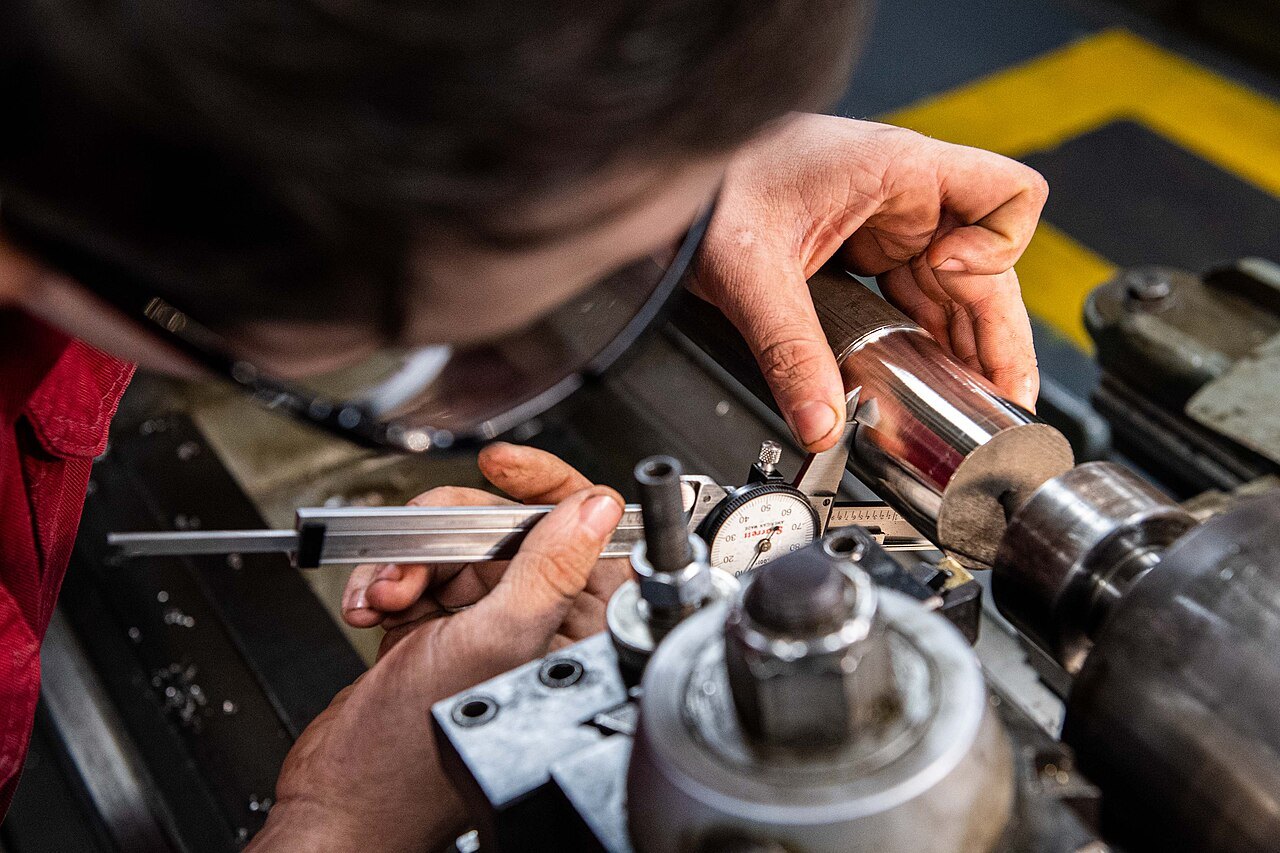
Featured photo: A machinery repairman measures the outside diameter of a steel part with a dial caliper aboard USS Ronald Reagan (CVN 76). U.S. Navy photo by Petty Officer 2nd Class Timothy Dimal, public domain, via Wikimedia Commons.