
Mercedes-Benz said on October 16, 2026 that it is rebuilding its global product development on PLM.AI, a new AI-native PLM backbone that ties development, procurement, production, sales, and after-sales to one knowledge base. The company is putting around half a billion euros into the program. Its target is up to 30% shorter development time, which it puts at about 17 months for a new vehicle.
Two vendors are carrying the load. CONTACT Software supplies the open core system, and Siemens extends its long-running role in physical design and digital validation. Mercedes keeps the target architecture, data models, and governance for itself, and says it retains full ownership and control of its data and of the AI models built on it. Efficiency gains of up to 50% are expected in individual engineering processes.

The interesting part is why. Mercedes already runs AI agents for material-cost optimization, certification and homologation, fault detection, and software development, but mostly inside single process steps. PLM.AI is meant to connect those agents through standardized data models and end-to-end integration of development data. The company’s own example is weight: one component change moves cost, crash behavior, hardware and software functions, and production, and specialized agents are supposed to weigh all of it at once.
Mercedes also says AI-driven simulation could cut physical testing by half over time, which pushes more validation weight onto CAE and onto the data that feeds it. Responsibility for product decisions stays with the engineering teams, the company stressed. That only holds if engineers can see which revision, which load case, and which assumptions an agent used.

The same week showed the pattern elsewhere. Schaeffler is consolidating engineering data on PTC Windchill+ with a T-Systems connector, and says structured, accessible data is the prerequisite for using AI in design. Aras announced on October 15 that Oticon Medical will replace its legacy document-management and PLM systems with Aras Innovator, starting with document management, change control, and product development. Consolidate the product record first, add AI second.
For N23D, the lesson is that an agent trading weight against crash and cost is only as trustworthy as the single model it reads. That is why N23D keeps CAD geometry, simulation results, the BOM, and change history on one revisioned record instead of stitching suites together. Mercedes spent half a billion euros to own that thread; most manufacturers will need it without the half billion.
Sources
- Mercedes-Benz Group: PLM.AI digitalises the entire global product development (Oct. 16, 2026)
- CONTACT Software: Mercedes-Benz digitalizes global product development with PLM.AI (press release, Oct. 16, 2026)
- T-Systems: Schaeffler accelerates product development with Windchill+ cloud PLM (Oct. 16, 2026)
- Aras: Oticon Medical selects Aras to build scalable digital product foundation (Oct. 15, 2026)
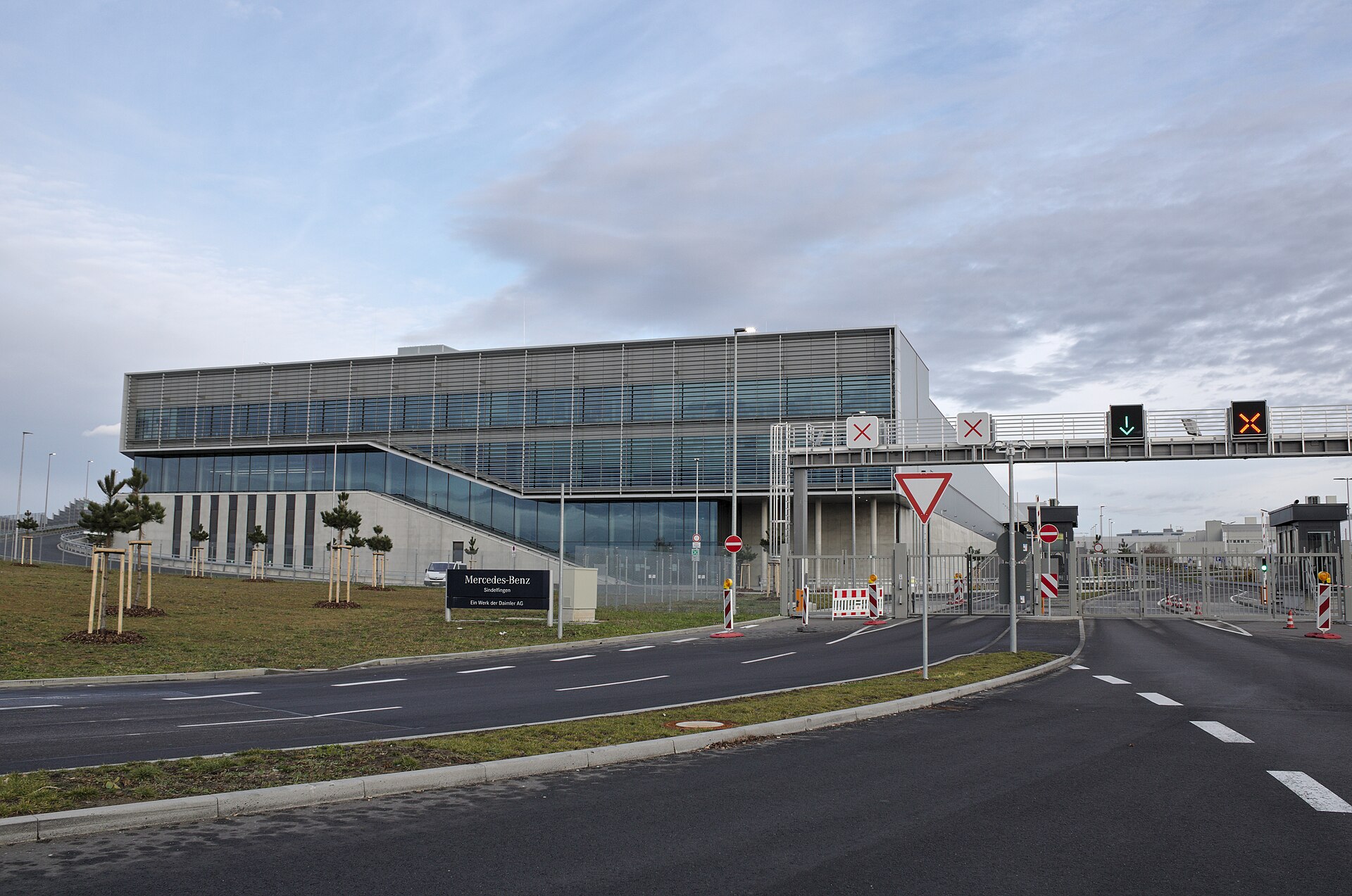
Featured photo: Mercedes-Benz Factory 56, Sindelfingen, by Alexander Migl via Wikimedia Commons, CC BY-SA 4.0.
