

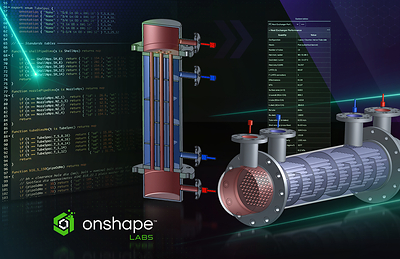
PTC announced the FeatureScript MCP Server as available through Onshape Labs on 13 August 2026, and the interesting part is not another chat window that dumps a solid. FeatureScript is the language Onshape Part Studios are already written in: the stock tools (Extrude, Fillet, Helix) are FeatureScript functions, custom features use the same mechanism, and the standard library is open to read.
The new server, built on the Model Context Protocol, lets a coding LLM such as Claude, ChatGPT, or Gemini sit on that language. An engineer describes the feature they need, and the agent writes, inserts, tests, and rewrites FeatureScript until it behaves. David Katzman, who runs Onshape and Arena at PTC, put it cleanly — not text-to-CAD, but “text-to-code-to-CAD.” DEVELOP3D’s preview is the concrete version: a helix from a PDF standard, a parameterized shelf grid, or a shell-and-tube exchanger as a FeatureScript feature with a cut list, not a dead mesh. A one-off body you cannot rebuild is a rendering. A custom feature in the tree is shop knowledge you can version.
The same editability problem shows up one layer down, in the kernel. A Zhejiang University group posted CADIR to arXiv on 1 August 2026: an executable intermediate representation on the OCCT geometry kernel (via OCP) that records modeling ops, parameters, constraints, and topology selections as a construction graph. Geometric Signature Matching finds the corresponding edges and faces after a parameter change or a backend hop.
Adapters replay that graph as native, editable feature history in FreeCAD, SolidWorks, and Fusion 360 — not as a dumb STEP body. On 100 held-out programs covering CADIR’s 115 operations (30,466 nodes), the paper reports a node-reconstruction rate of 1.0000 on all three backends, geometric IoU of 0.9374 / 0.9762 / 0.9449, and post-reconstruction edit success of 1.0000 / 0.9796 / 0.9184 (FreeCAD / Fusion 360 / SolidWorks). Those leftover misses are what practicing CAD people already know: kernels disagree on tolerances, fillets, and which “native” feature even exists. Static B-rep generators throw away construction history. If AI is going to sit in production CAD, it has to emit a graph of operations, not a colored lump.

What matters is the shared argument, not the vendor scoreboard. AI that only produces geometry is a demo. AI that writes a FeatureScript feature, or an OCCT construction graph that still fillets after you change a hole, is closer to how design intent has to travel if CAD is going to stay the definition of the product. That is why N23D treats CAD as a view on a shared model — the solid a designer authors is the solid manufacturing and the product record should read — and why a single change model beats a stack of translators.
None of this retires the engineer. PTC’s own coverage, and ARC’s note on the Labs launch, still put review on the human: function, manufacture, safety, code. The useful test for the next few months is simple. Can someone who was not in the chat open the feature, change a parameter, and get a model that rebuilds?
Sources / References
- PTC — Onshape FeatureScript MCP Server announcement
- PR Newswire reprint
- DEVELOP3D FeatureScript MCP preview
- Engineering.com — Onshape is bracing for an AI explosion
- ARC Advisory Group
- Onshape FeatureScript introduction
- Onshape FeatureScript language
- Onshape FeatureScript Standard Library
- Model Context Protocol specification (2026-07-28)
- CADIR paper arXiv:2608.00891
- CADIR HTML
- CADIR PDF
- CADIR code SimpleCADAPI
- CC BY 4.0
- N23D CAD
- N23D platform

Leave a Reply