
DANAOS Projects released ProjectVIEW ERP v12 on Oct. 16, and the headline change is not the AI. It is a new Production module that covers project-based manufacturing end to end. Companies that build to project, order or contract can now run production in the same system as their estimating, budgeting, procurement and cost control. DANAOS sells into construction, EPC, infrastructure, shipbuilding and marine engineering, where a single job can be a hull, a plant or a bridge.
That matters to anyone running a project office in engineer-to-order work. The project plan usually lives in one tool and the production schedule in another, often a spreadsheet next to the shop. When a block slips in fabrication, the cost-to-complete forecast finds out days later, after someone reconciles the two. Putting production inside the system that already holds the budget and the purchase orders removes that handoff.

.jpg)
Version 12 also builds ProjectVIEW AI into how users manage, execute and optimize their processes, working on one unified data set: the operational data captured from every project plus the company’s internal data. A new MCP connector, the open standard for linking AI assistants to business systems, lets Claude or ChatGPT work directly with ProjectVIEW. Users can run operations without opening ERP screens, ask questions of their own data in plain language, build dashboards and KPIs, and create their own agents.
Others in project controls moved the same direction this month. Tempo shipped an MCP server on Oct. 6 that answers where time went, which teams are over capacity and when a budget runs out; access is read-only and runs under each person’s existing permissions. On Oct. 13, Advanced Management Insight announced TrueProject Zero Effort Decision Intelligence, a predictive layer over ERP, scheduling and financial systems. Its own figures claim six weeks earlier warning of project risk on average, 10 hours saved per project manager each week, and up to 30 percent potential cost reduction.
_Shipyard,_from_Jack_Block_Park_01.jpg)
The two approaches split on one question. TrueProject sits on top of the systems a company already has and reads across them; DANAOS is betting that production belongs inside the same record as the cost ledger. An assistant that has to reconcile five systems is reconciling five versions of the truth, and its answer is only as current as the slowest sync. A vendor’s six-week figure is a claim to test on your own projects, not a promise.
For N23D, PMO is not a separate scheduling tool bolted beside the plant. The project schedule, the work orders from MES, the purchase orders and actual costs in ERP, and the BOM from PLM sit on one record. When a production step slips, cost-to-complete moves with it, and any question asked of the system gets the same answer the ledger has.
Sources
- ProjectVIEW ERP v12 Is Now Available to All Clients, DANAOS Projects (Oct. 16, 2026)
- TrueProject Introduces Zero Effort Decision Intelligence to Predict Project Risk and Protect Business Outcomes, Advanced Management Insight (Oct. 13, 2026)
- Tempo MCP Server Lets Engineering and PMO Leaders Ask AI Where Their Time and Budget Went, Business Wire (Oct. 6, 2026)
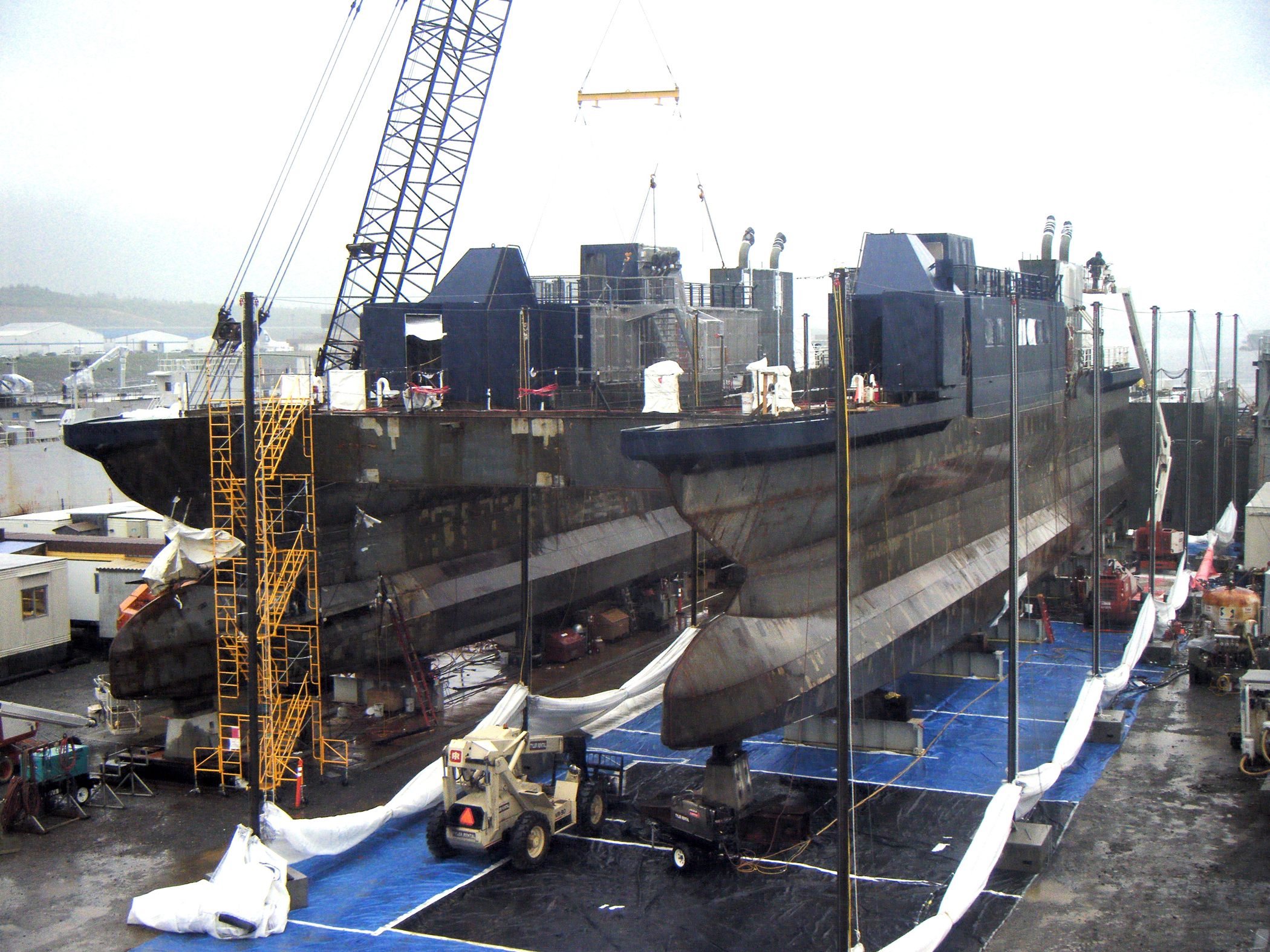
Featured photo: Office of Naval Research E-Craft under construction at Alaska Ship and Drydock, U.S. Navy photo, public domain, via Wikimedia Commons.
