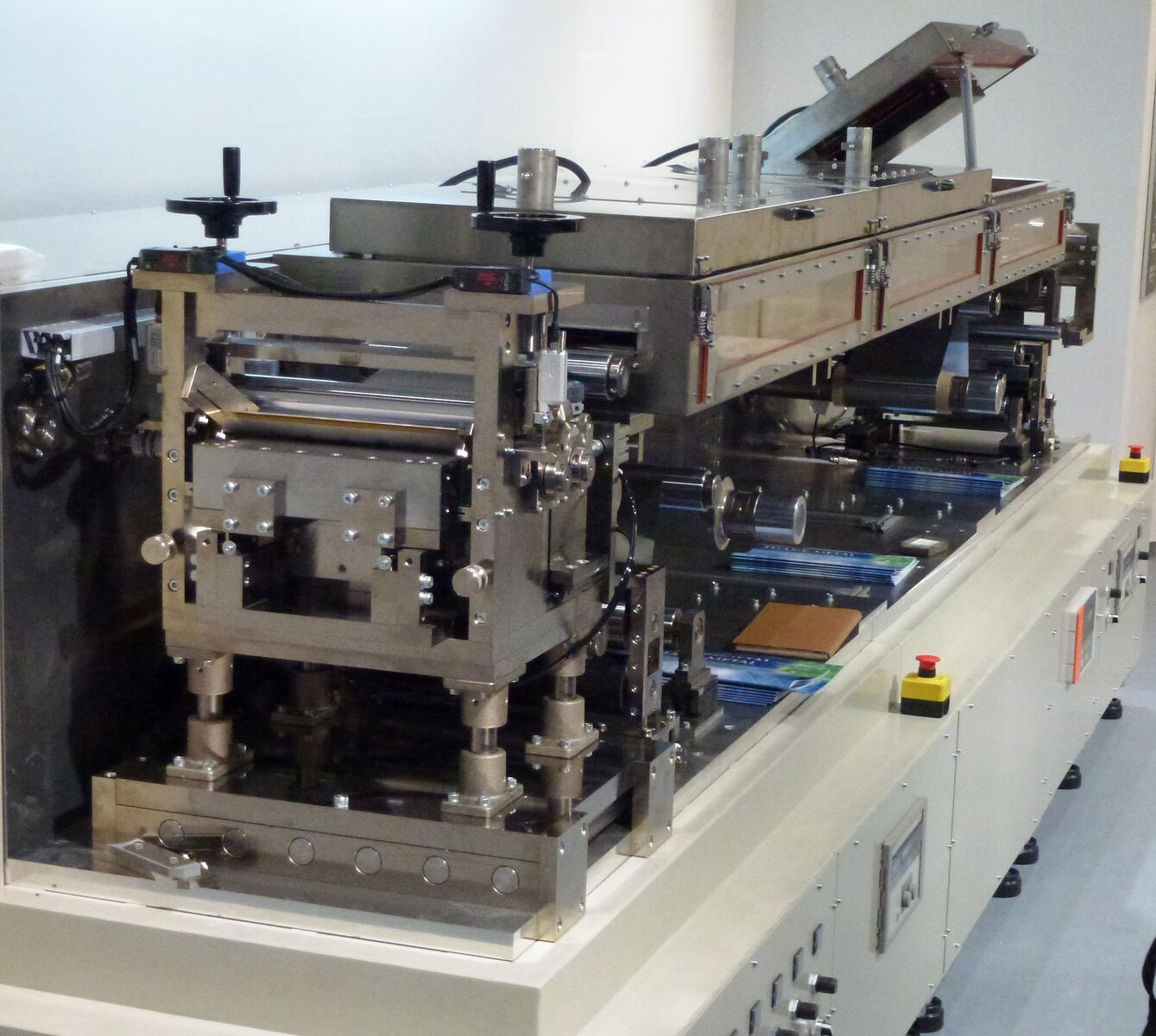
Ateios Systems brought a 50-MWh-per-year lithium-ion electrode coating line online at its Newberry, Indiana plant on October 1, 2026—and is already shipping RaiCore® electrodes for consumer electronics, defense, aerospace, and mobility. The line runs on RaiCure®: liquid monomers coat like a wet slurry, then an electron beam crosslinks them into a finished electrode in seconds instead of baking solvents out of a thermal drying oven.
That process change is the materials story. RaiCure uses less than 1% binder, claims roughly 2× electronic conductivity versus conventional PVDF electrodes, and targets areal loadings of 6–8 mAh/cm² so more of the foil carries active material instead of inactive mass. Ateios says binder stability above 4.2 V can unlock 20–30% higher specific capacity from the same electrochemically active material—while coating at up to 30 m/min on a 300 mm web in single-, double-, continuous, or custom-gap modes.
Founder and CEO Dr. Rajan Kumar frames the economics bluntly: technology dropped into an existing pilot tool that can “compete with a GWh-scale coater at one-fifth the capital and operating cost.” Customers get higher energy density and baseline-vs-RaiCure trials in weeks instead of quarters, with quality aimed at OEM qualification standards in Asia and the U.S.—a materials pilot path that does not require buying a full solvent-oven coater first.
Speed to sample matters as much as line rate. Coating trials complete in two to four weeks versus the three-to-six-month programs common on solvent lines, with stocked LCO, LFP, NMC, and graphite from established suppliers cutting the 10–12 week first-run materials wait. Stock electrodes—including NMC811—are already shipping, and the same formulation path can scale through toll coaters such as Kodak. Expansion work covers silicon, sodium-ion, and LTO.
Supply-chain materials compliance is built in: Intertek-tested electrodes at <20 ppm PFAS (“forever chemicals”), PFA-free chemistry, and NSF Energy Storage Engine support for non-FEOC suppliers ahead of the January 1, 2027 NDAA window. Assembly support via the Battery Innovation Center lets OEMs evaluate cells without standing up their own coating line—then meet Ateios at The Battery Show North America October 12–15 (Booth 4414).
For N23D, electrode platforms like RaiCure are another reminder that materials data—binder fraction, loading, voltage window, PFAS/FEOC provenance—belongs next to geometry and process, not in a vendor spreadsheet. N23D targets that as one native Rust binary: local-first MAT beside vaulted CAM and PLM you own when the coater SKU or cloud seat changes.