
Institute of Science Tokyo just cut the hands-on grind of ceramic sample prep from one or two hours down to about three minutes. In a release dated today, Assistant Professor Sou Yasuhara’s team shows how cellulose nanofiber (CNF) dispersions let researchers mix liquid powder stocks instead of weighing, dry-mixing and pressing every composition by hand. The work, published in the Journal of Materials Chemistry C, keeps drying and firing on the clock but removes the bottleneck that usually slows dielectric screening.
Ceramic powders go into water with CNFs first. Those plant-derived nanofibers keep particles dispersed, act as a binder and make the slurry thixotropic, so a new composition is just a ratio mix, a dry and a sinter. No fresh powder weighing, no mortar marathon and no pellet press for every trial. CNFs burn out during high-temperature firing, and barium titanate samples made this way matched conventional density, crystal structure and dielectric numbers. That validation let the team move into binary and ternary titanate systems without buying a robot lab.

The payoff was a composition, not just a process. Screening barium–strontium–calcium titanate–zirconate mixes pointed to Ba0.55Sr0.15Ca0.30(Ti0.91Zr0.09)O3: a dielectric constant near 4,000 with strong stability from 30 °C to 125 °C. That window is where many automotive and power-electronics capacitors live. Because each composition needs only a small powder charge and cheap kit, ideas that used to die on the weighing bench can now get a sintered pellet and a real measurement.
The same week, MIT materials researchers flipped another assembly dogma. Instead of rigid ligands that lock nanoparticle bonds at fixed angles, Rob Macfarlane’s group used super-flexible charged connectors that bend and settle into stable networks. In Nature Materials they show that particle size and ligand length set how many neighbors each particle gets, opening lattices that rigid-linker recipes never reached. Faster ceramic screens and flexible nanoparticle packing are different tools with the same goal: more say over structure before the part ships.

Both stories expose the same materials gap on the plant floor. A dielectric that holds εr across temperature, or a nanoparticle lattice with a new coordination number, is useless if the BOM still points at a generic grade and a PDF datasheet. Engineers need the composition, process route, measured properties and approved substitutions in one place that CAD, CAM and simulation can read. That is the job of a real MAT stack, not a shared drive of sintered coupons.
N23D treats materials as first-class product data. Grades, process windows, test results and substitutions live next to geometry in the same Rust application as CAD, CAM, CAE and PLM. When a lab finds a capacitor ceramic that stays stable to 125 °C, the approved composition can travel with the part revision instead of living in someone’s notebook.
Sources
- Cellulose nanofibers speed up the search for new ceramics, Institute of Science Tokyo (Nov. 6, 2026)
- Sou Yasuhara et al., High-throughput ceramics processing method using cellulose nanofiber dispersions for rapid materials exploration, Journal of Materials Chemistry C (2026), DOI: 10.1039/d6tc01175f
- Accelerating discovery of ceramic materials using cellulose nanofiber dispersions, Institute of Science Tokyo (Aug. 5, 2026)
- A flexible new route to designer materials built from nanoparticles, MIT News (Nov. 2, 2026)
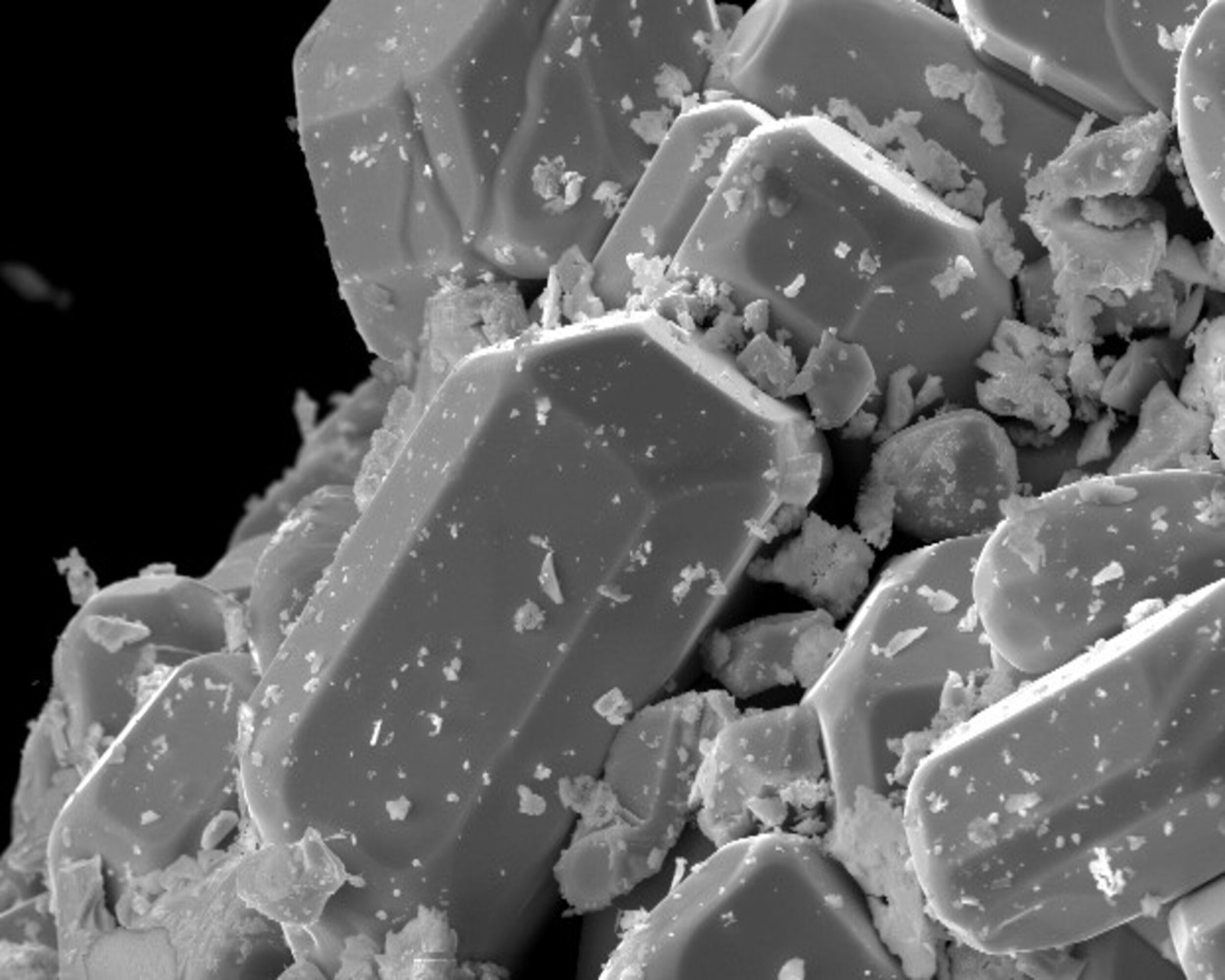
Featured photo: scanning electron micrograph of sintered powders. Photo: Joyita Bhattacharya / Unsplash.