
On Oct. 19, Siemens unveiled new AI applications running in live production at its Electronics Factory in Erlangen, Germany, the first milestone of the autonomous factory program it announced with NVIDIA at CES in January. The headline figure: a fully virtual production ramp-up cuts engineering effort by up to 85% and time-to-market for new circuit board assemblies by up to 40%. Manufacturing Digital reports that the plant already runs about 100 AI agents across production, logistics, inspection and maintenance, as part of a US$560 million investment in the site.
The 85% comes from inspection setup. Preparing automated optical inspection for a new board used to take several weeks, because engineers had to wait for a physical prototype to train the vision system and then program the machines by hand. Now photorealistic images generated from the board’s digital twin, using NVIDIA Cosmos world models, train the inspection system before the first board exists. A Siemens U.S. release on Oct. 21 says the workflow links Teamcenter PLM and Process Preparation X, and targets more than 40% fewer false calls and over 5% better first-pass yield, so the plant can absorb product changes three to five times a week.

The second application is production planning. When new orders arrive, an AI agent generates several production scenarios and shows planners how each one moves the plant’s KPIs, balancing capacity, material availability, delivery dates and line assignments. Each proposal is checked against a digital twin of the whole factory before it is released, and Siemens puts the savings at up to 20%. Tech Times notes the honest caveat: every number depends on how faithfully the twin matches the real floor, and Siemens has not published how inspection models trained on synthetic images perform against real defects.
The rest of the MES market moved the same way this week. On Oct. 20, Critical Manufacturing released version 12.0, with AI agents that answer questions and build dashboards on the same data model that runs execution, producing governed configuration rather than generated code. Its new Global Data Orchestrator pushes master data to every site through controlled change packages with dry-run validation. Parsec’s TrakSYS 14.1 lets an AI assistant propose MES configuration changes that a person must approve before anything runs, and on Oct. 22 L2L launched Shop Floor Execution, which combines production, maintenance and dispatch with voice-driven dispatching and suggested fixes drawn from past repairs.

All four announcements follow the same pattern: software proposes a change, the change is checked against a model or a dry run first, and a person approves it. Siemens says its Erlangen plant expects to make changes three to five times a week, so the useful question for a buyer is where that approval is recorded. If the reason for a schedule change or a new inspection program is not stored with the part revision and the work order, the plant cannot audit it later, even when the AI made the right call.
N23D is building its MES in Rust so that every change to a routing, recipe or inspection plan is a change record with a dry run against the current floor model, an approval step and full history, tied to the part revision in PLM. When an inspection flags a defect, it is designed to open the QMS nonconformance on that serial number directly, so the trail from design to the finished unit stays in one record.
Sources
- Siemens partners with NVIDIA to advance AI-driven, autonomous factories, Siemens AG press release (Oct. 19, 2026)
- Siemens and NVIDIA advance AI-powered PCB inspection from Digital Twin to factory, Siemens USA (Oct. 21, 2026)
- How 100 AI Agents Run Siemens & NVIDIA’s German Plant, Manufacturing Digital (Oct. 20, 2026)
- NVIDIA, Siemens Prove Autonomous Factory AI Needs No Prototypes; Erlangen Engineering Down 85%, Tech Times (Oct. 20, 2026)
- Critical Manufacturing Expands Industrial Operations Platform with Purpose-Built AI Agents, Critical Manufacturing (Oct. 20, 2026)
- Parsec Automation Introduces TrakSYS MES AI-Assisted Configuration, Business Wire (Oct. 13, 2026)
- L2L Unveils AI-Powered Shop Floor Execution Platform, L2L (Oct. 22, 2026)
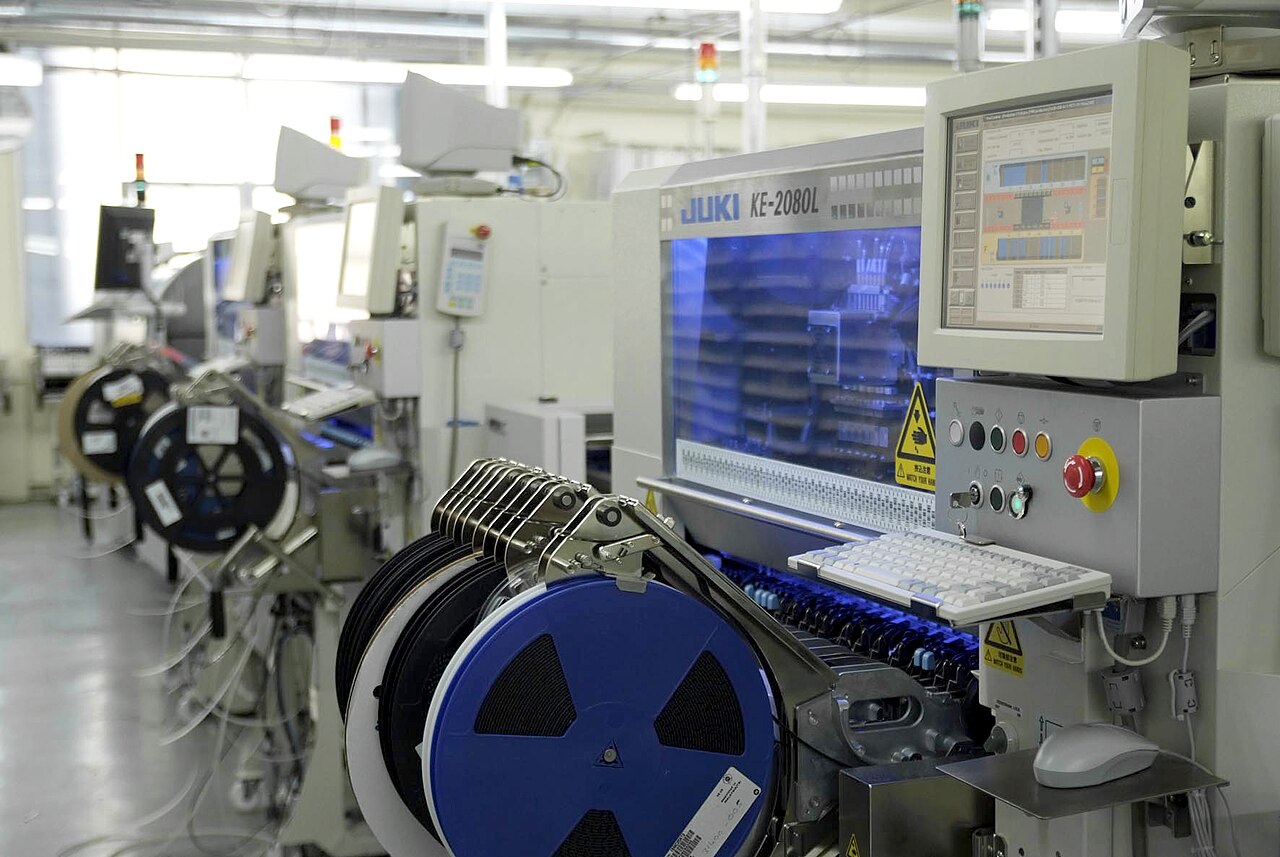
Featured photo: Juki KE-2080L SMT placement machine by Megger Ltd., CC BY 3.0, via Wikimedia Commons.
