
Customers don’t talk in tolerances. They say things like “I don’t want the lid to be in the way when I put the part in.” Somewhere between that sentence and a released drawing, someone turns it into a number, usually in an email or a spreadsheet that nobody can find when the product comes back. When the number turns out wrong, nobody can say who picked it or why.
N23D is being built to capture that step instead of losing it. The customer’s statement goes in exactly as they said it. N23D then asks the follow-up questions a good engineer would: how big is the object, which side does it go in from, does the lid have to stay open on its own. The answers become a requirement with a number, a unit and a tolerance, and a person approves it before it counts.
A requirement can carry two levels. There’s a must-meet minimum, say a lid that opens at least 90 degrees, and a nice-to-have target, say 110 degrees. Both sit on the same record as the customer’s original words and the reasoning that connects them, so six months later the why is still there next to the what.
That record doesn’t stay in CRM. It’s the same one CAD designs against, PLM revises, and the kinematics check in CAE reads when the finished assembly is tested for range of motion, clearance and collisions, pass or fail against the numbers the customer approved. One native Rust binary, one record. One platform. Full digital thread.
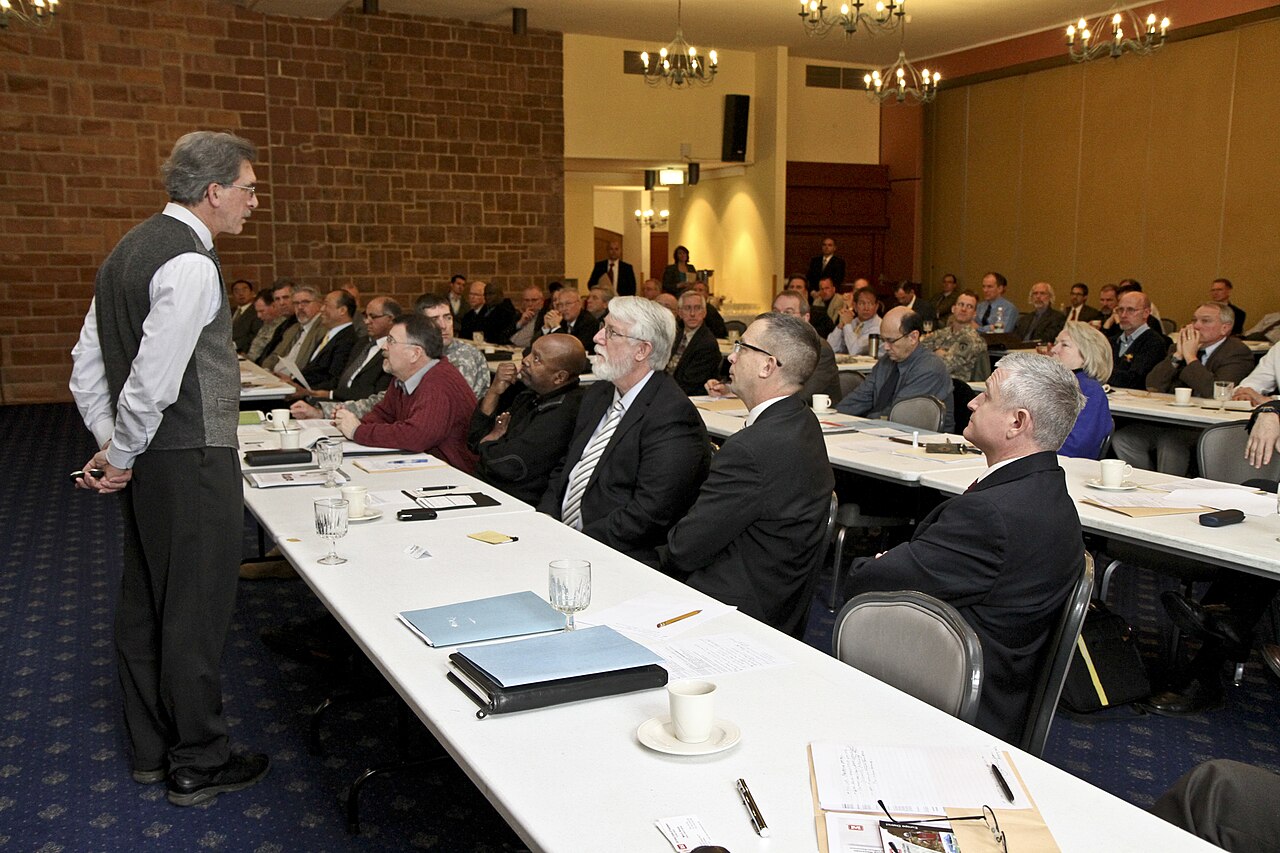
Featured photo: Philip Cohen of the U.S. Army Corps of Engineers Europe District leads a discussion at the district’s Customer Partnering Workshop, Wiesbaden Army Airfield, Jan. 25, 2012. U.S. Army Corps of Engineers photo by Carol E. Davis, public domain, via Wikimedia Commons.
