Every engineering team has the story. A designer spends a week on a new bracket, never checks it in because it isn’t ready, and then the laptop dies, gets stolen, or gets reimaged by IT on a Friday afternoon. The released files are safe in the vault. The work that mattered most, the part nobody had approved yet, is gone.
That happens because most CAD and PDM tools treat “saved” and “safe” as the same thing. Until you check a file in, it lives in one place: the drive in front of you. Cloud sync fixes that by putting your work on someone else’s server, where you rent it back by the month.
In N23D, work in progress is kept in triplicate by default: on your device, on a peer at your own site, and in an offline vault copy. Each save is split into encrypted, content-addressed blocks and copied automatically to machines your company controls, not to a vendor cloud. You sign in with Microsoft Entra, but your data plane stays local-first and doesn’t need the internet to keep working. A wiped laptop costs you a re-sync, not a week.
Backup is not release, though. A copy existing on three machines doesn’t make it official. Release still goes through PLM and the change board in CCB, on the same vault as the geometry in CAD, all in one Rust binary. One platform. Full digital thread, and it starts before anything is approved.
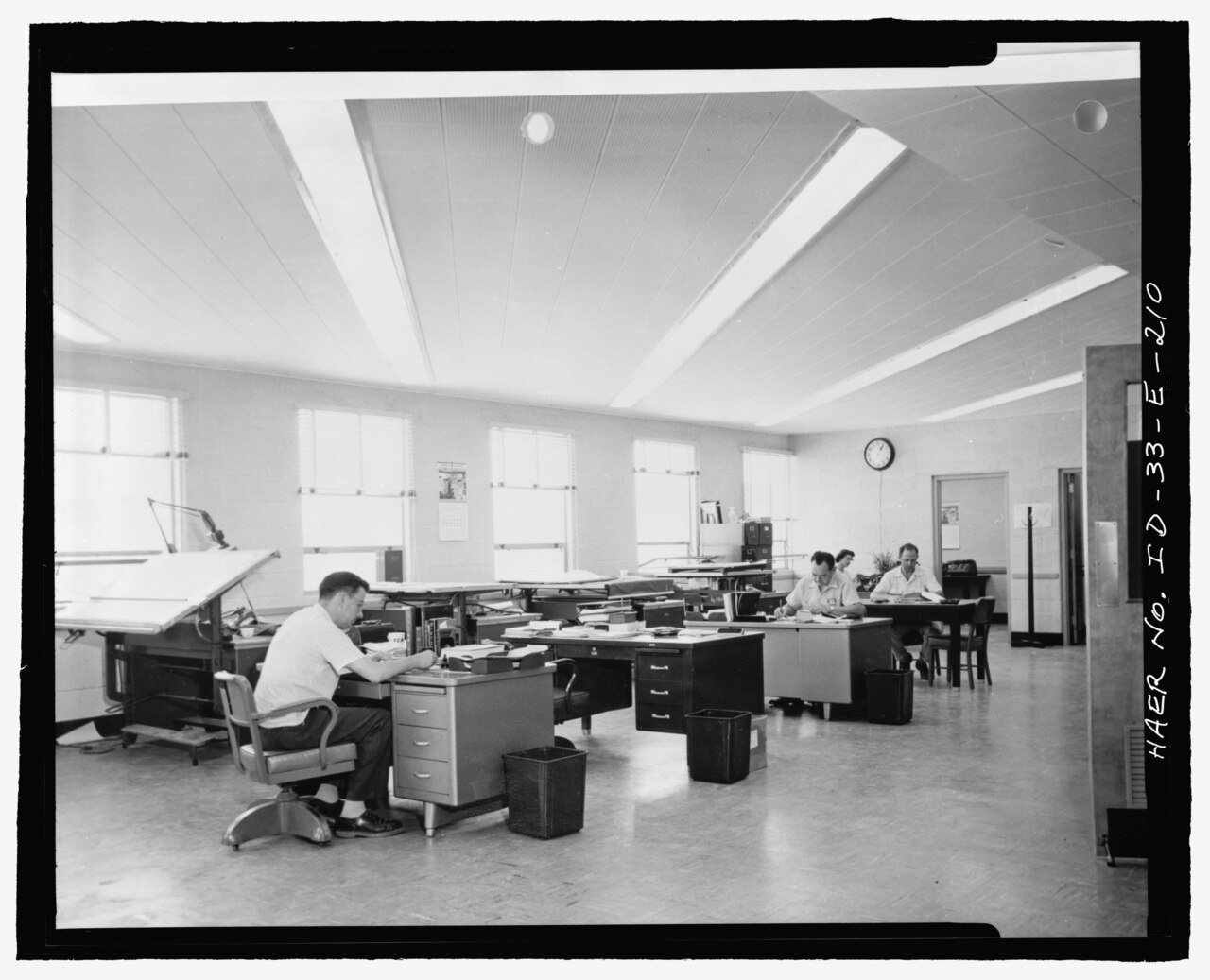
Featured photo: the drafting room in use at the Administration Building (TAN-602), Test Area North, Idaho National Engineering Laboratory, July 12, 1954. Historic American Engineering Record, via Wikimedia Commons (public domain).