Siemens and Productive Machines described on Nov. 3 what happened when an aerospace manufacturer making engine and structural parts ran SenseNC, a physics-based optimizer for feeds and speeds, inside NX CAM. On the first aluminum casting, cycle time fell from 4 hours 51 minutes to 3 hours 57 minutes, about 19%, or 53 minutes off every part. Across the two parts that went into production, Siemens says the savings added up to more than 1,000 hours of machine capacity over six months, without buying a new machine.
The usual loop is familiar to any programmer: post the program, run it, find chatter or a broken tool, go back to CAM, change the cutting conditions and try again. SenseNC moves that work ahead of the first cut. Its Feeds module raises the feed rate where the cut is light and lowers it where load climbs, checking tool stress and the machine’s torque and power limits along the toolpath. Its Finesse module uses a 40-second tap test on the tool and holder to pick spindle speeds less likely to chatter. Productive Machines founder Erdem Ozturk says deployments typically save $40,000 to $140,000 per machine per year, from roughly 20% shorter cycles and about 11% lower tooling cost.
Mastercam is going after a different delay: waiting on the computer. Its Nov. 9 recap of the Mastercam 2027 rollout calls EverPath “one of the most significant technology advancements in company history.” Instead of change, regenerate, check, repeat, EverPath updates the toolpath live as parameters change, with interactive editing and dynamic collision avoidance. It is in public beta through Mastercam Connect and planned for Mastercam 2027.R2. The 2027 release itself adds Guide Parallel and Guide Morph strategies for unified multiaxis toolpaths, fixture-aware collision checking in multiaxis pocketing, and a Copilot assistant that can change parameters across several operations at once.
CloudNC is chipping at setup instead. CAM Assist 2.5, released Nov. 6, lets a programmer upload the 2D drawing with the 3D model; the AI pulls the hole callouts, matches them to features and proposes hole-making strategies for review. CloudNC says tooling setup was “the single biggest barrier” to adoption, so the update lets users define a tool set per part and add recommended tools from a global database in one click. It works inside Mastercam, NX, Fusion, GibbsCAM and SolidCAM at no added cost to subscribers.
Smaller vendors are moving the same direction. MeshCAM V9 Build 62 (Nov. 7) says 3D toolpath calculation is now 2 to 100 times faster in some cases, and fixes gouges with V-bits and tapered tools near steep faces. ENCY 3.2 (Nov. 6) lets programmers set an allowable scallop height in finishing, so pass spacing follows a geometric limit, and trims face-milling passes around the fixtures. Across all of these, the common thread is fewer trips back and forth between the CAM screen and the machine.
That trip is also a data problem. In most shops the toolpath lives in CAM, the cutting data in a spreadsheet or the tool crib, the tap-test results in a separate portal and the actual cycle times in the machine log. In N23D, CAM runs in the same Rust application as simulation and MES, so the tool, the holder’s measured dynamics, the optimized feeds and the cycle time the machine actually ran sit on one record. When a feed change saves 53 minutes, the next programmer can see it, and so can whoever plans the schedule.
Sources
- How Productive Machines and Siemens NX CAM Are Advancing CNC Machining Together, Siemens (Nov. 3, 2026)
- Mastercam 2027: Smarter Workflows, Faster Programming, and a Glimpse into the Future, Mastercam (Nov. 9, 2026)
- CAM Assist 2.5: Giving Programmers More Control, With Less Setup, CloudNC (Nov. 6, 2026)
- MeshCAM V9 Build 62, GRZ Software (Nov. 7, 2026)
- ENCY 3.2: Reuse Tool Setups, Control Surface Finish, Position Fixtures Faster, ENCY (Nov. 6, 2026)
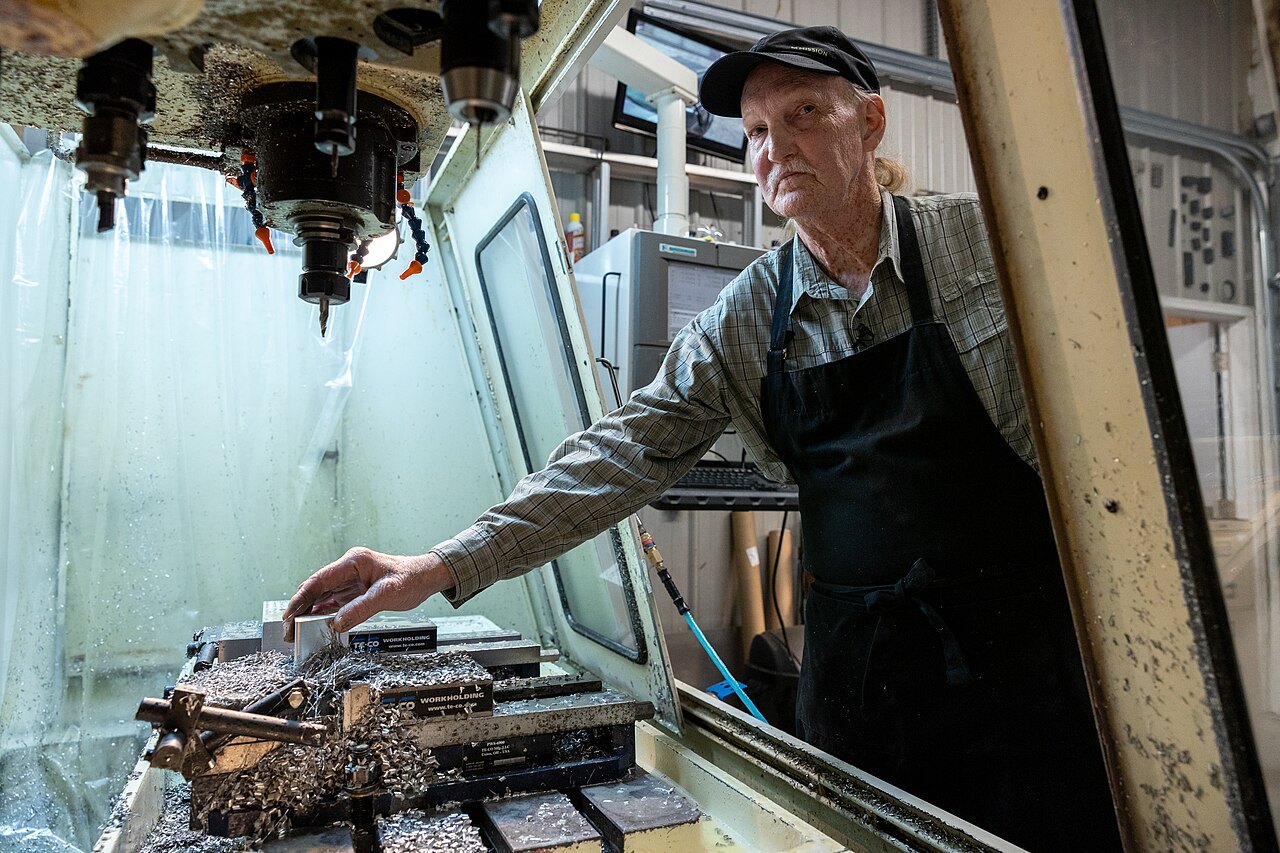
Featured photo: A machinist removes a part just carved from a block of aluminum in a NASA Goddard machine shop. Photo by NASA/Sophia Roberts, public domain, via Wikimedia Commons.